An Eternity For Every Tear They Mock
With the sinister organ and heavily reverbed vocals, “Grievance Merchants” sounds like a sermon designed to counterprogram hateful forces.
If you're new to Mundane Mayhem, here's a little more about why I started it. If you find this newsletter compelling, I hope you will become a paid subscriber. For just $4 a month, you get every new post, plus access to the full archive and the ability to leave comments and interact with other DBT fans, who we all know are excellent hangs.
I think of “Grievance Merchants” as Mike Cooley’s incel song. Others have interpreted it as a song about white supremacists or mass shooters. Exactly who the “aggrieved” party is doesn’t matter. The real blame rests in the hands of the titular grievance merchants, who specialize in offering troubled men a place to direct their resentments. “Incel” and “manosphere” may be neologisms, but the tactic of manipulating resentful men is as old as men.
Mundane Mayhem is a reader-supported publication. Please consider becoming a subscriber for just $4 a month or leaving a tip.
This week, I watched Nuremberg, about the post-war trials of the Nazi high command. The movie is good, not great, but worth a watch. In one scene, a psychiatrist asks Hermann Göring what persuaded him to follow Hitler. His response is chilling and familiar:
"He made us feel German again. The war had seen Germany crushed, and along comes a man who says, ‘we can reclaim our former glory.’ . . . Even with his anti-Semitism, it served a practical purpose. It brought towards us men who needed something else to focus their emotions. Something else to blame.”
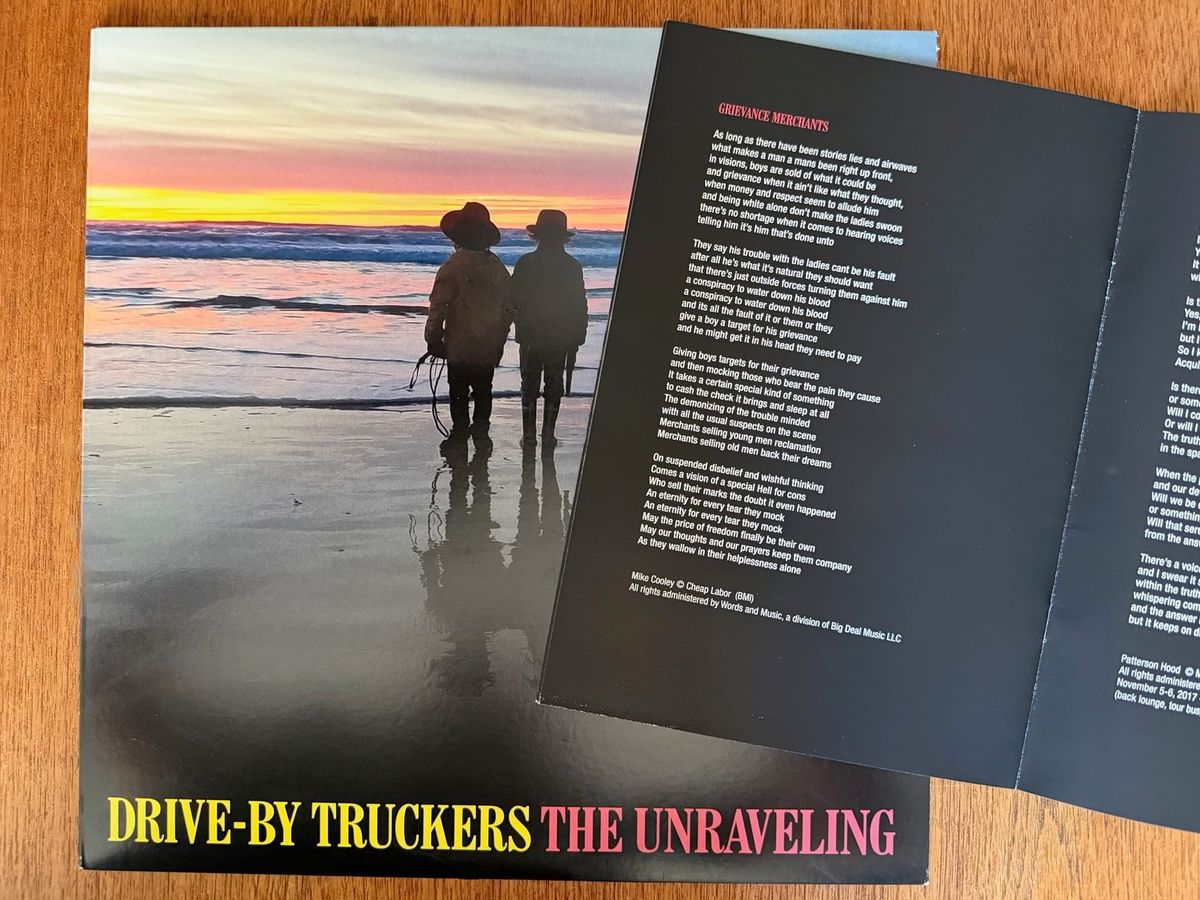
“Grievance Merchants” is one of the Drive-By Truckers songs I’ve listened to more than any other — very loudly and on repeat. I am eternally awed by it. I have read the words aloud like a poem, and the lyrics give me chills. I think it’s some of Cooley’s best writing, and I have to resist the urge to break it down line by line like I’m writing a college lit paper.
Cooley’s vocals sound like a fire and brimstone preacher, punctuated by a gospel choir of guitars.
Released in January 2020, The Unraveling album is an appropriately dark and ominous masterpiece. To quote the liner notes, “It’s going to take more than thoughts and prayers to solve this shit.” The nine lean tracks were recorded more or less live, often in one or two takes, and you can feel the outrage, anger, and frustration in every note.
 Nancy Einhart
The combined effect of the last two songs — Mike Cooley’s “Grievance Merchants” and Patterson Hood’s “Awaiting Resurrection” — reminds me of the epic pairing of “Shut Up and Get on the Plane” and “Angels and Fuselage.” Like Southern Rock Opera, The Unraveling ends with a bang, but instead of a plane crashing, it’s the great American experiment.
A few years ago, I had a gig writing content for a psychologist, where I learned about terror management theory (or TMT). TMT is based on the premise that pretty much all humans have fear or anxiety about their own mortality, and one weapon to stave off that terror is with a sense of importance. People want to believe that they are significant.
Nancy Einhart
One of the darker ways that people manage their fear of death is by identifying as part of a group that they believe is superior. Religion, misogyny, and white supremacy provide certain people with a sense of belonging — and offer a convenient lever for con men to pull.
With the sinister organ and heavily reverbed vocals, “Grievance Merchants” sounds like a sermon designed to counterprogram darker forces. Like most confidence games, this one is tried and tested, as Cooley tells us in the first verse:
As long as there have been stories, lies, and airwaves
what makes a man a man’s been right up front.
In visions, boys are sold of what it could be
and grievance when it ain’t like what they thought.
When money and respect seem to elude him
and being white alone don’t make the ladies swoon,
there’s no shortage when it comes to hearing voices
telling him it’s him that’s done unto.
In “Made Up English Oceans,” Cooley excoriates political operatives who leverage racism to win white Southern voters. Fast-forward to 2020, and this song imagines a bunch of angry white boys who feel betrayed that they didn’t inherit the earth like they were promised.
This song imagines a bunch of angry white boys who feel betrayed that they didn’t inherit the earth like they were promised.
In “Grievance Merchants,” Cooley aims his vitriol at the voices who spew conspiracies, stoking hatred and fear of women, immigrants, non-whites, and different kinds of whites. For good measure, Cooley also side-eyes transphobes, with the “it or them or they” line:
They say his trouble with the ladies can’t be his fault
after all he’s what it’s natural they should want
that there’s just outside forces turning them against him
a conspiracy to water down his blood
a conspiracy to water down his blood
and it’s all the fault of “it” or “them” or “they”
give a boy a target for his grievance
and he might get it in his head they need to pay.
Cooley isn’t excusing the behavior of the manipulated manosphere masses, but he directs the most fury at the grievance merchants themselves. After all, it takes a special kind of asshole to cash those checks and still sleep at night.
The song concludes with a truly epic crescendo, the volume and malice and reverb turned up to 11, as the song imagines the special hell that awaits con men who capitalize on grievance. Cooley’s vocals sound like a fire and brimstone preacher, punctuated by a gospel choir of guitars, as if it’s the only way to break through this mass psychosis:
On suspended disbelief and wishful thinking
comes a vision of a special hell for cons
who sell their marks the doubt it even happened
an eternity for every tear they mock
an eternity for every tear they mock
may the price of freedom finally be their own
may our thoughts and our prayers keep them company
as they wallow in their helplessness alone
may our thoughts and our prayers keep them company
as they wallow in their helplessness alone
You know I love how Cooley says comp'ny. The cynical mention of thoughts and prayers nods to Patterson’s “Thoughts and Prayers” on the same album, which attempts to envision a world without mass shootings and conspiracy-theory con artists capable of convincing people the earth is flat.
Nancy Einhart
As we know from DBT canon, politicians who leverage gullible people for their own ambition don’t get a pass. In “The Three Great Alabama Icons,” Patterson imagines that longtime Alabama Governor George Wallace ends up in hell, where the devil (also a Southerner) brews up sweet tea when company is coming over. The “special hell for cons” doesn’t even have tea.