Glenn Raucher: "The Art You Need Finds You"
While Glenn may be a relatively “new” fan, he is a powerful thread in the tapestry of the DBT community.
Although fan interviews will always be free, Mundane Mayhem is a reader-supported publication, so please consider supporting my work by becoming a paid subscriber. Subscribe below or forward this email to your friends!
As a music fan, Glenn Raucher considers himself “really polyglot with my listening” — capable of consuming a diversity of bands, albums, or genres in a given week. But in 2016, during a truly awful year in his life, Glenn found himself unable to listen to anything but Drive-By Truckers — specifically, the It’s Great to Be Alive album.
“Never has a record captured me like that one,” Glenn says. “That year, more than any time in my life, I needed something that would be cathartic and profound and musically compelling. I think if you're a lucky person, the art you need finds you when you need it.”
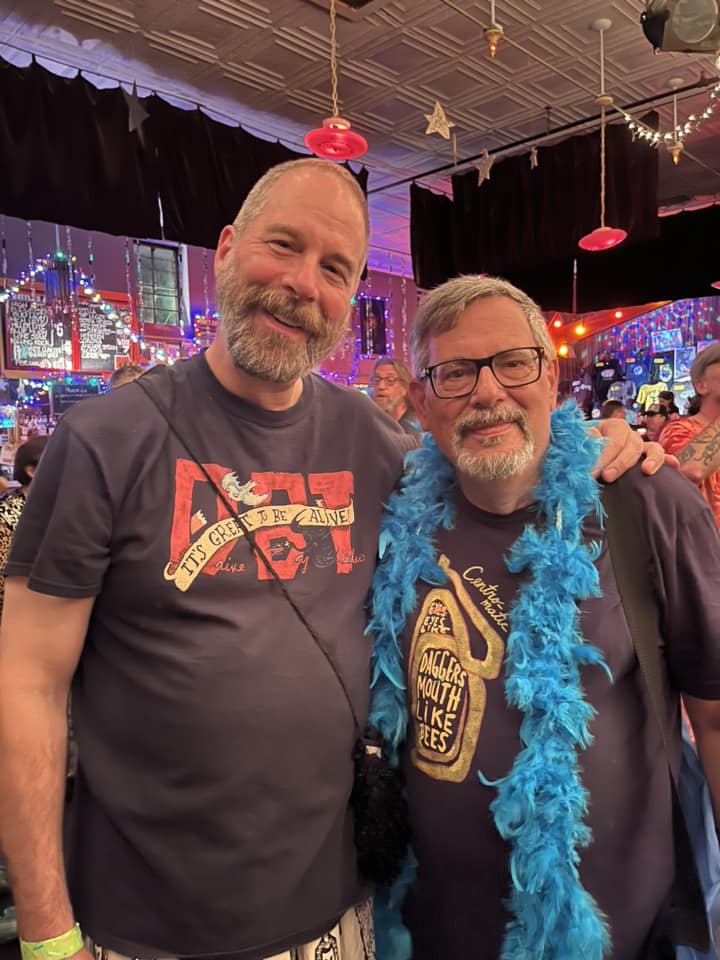
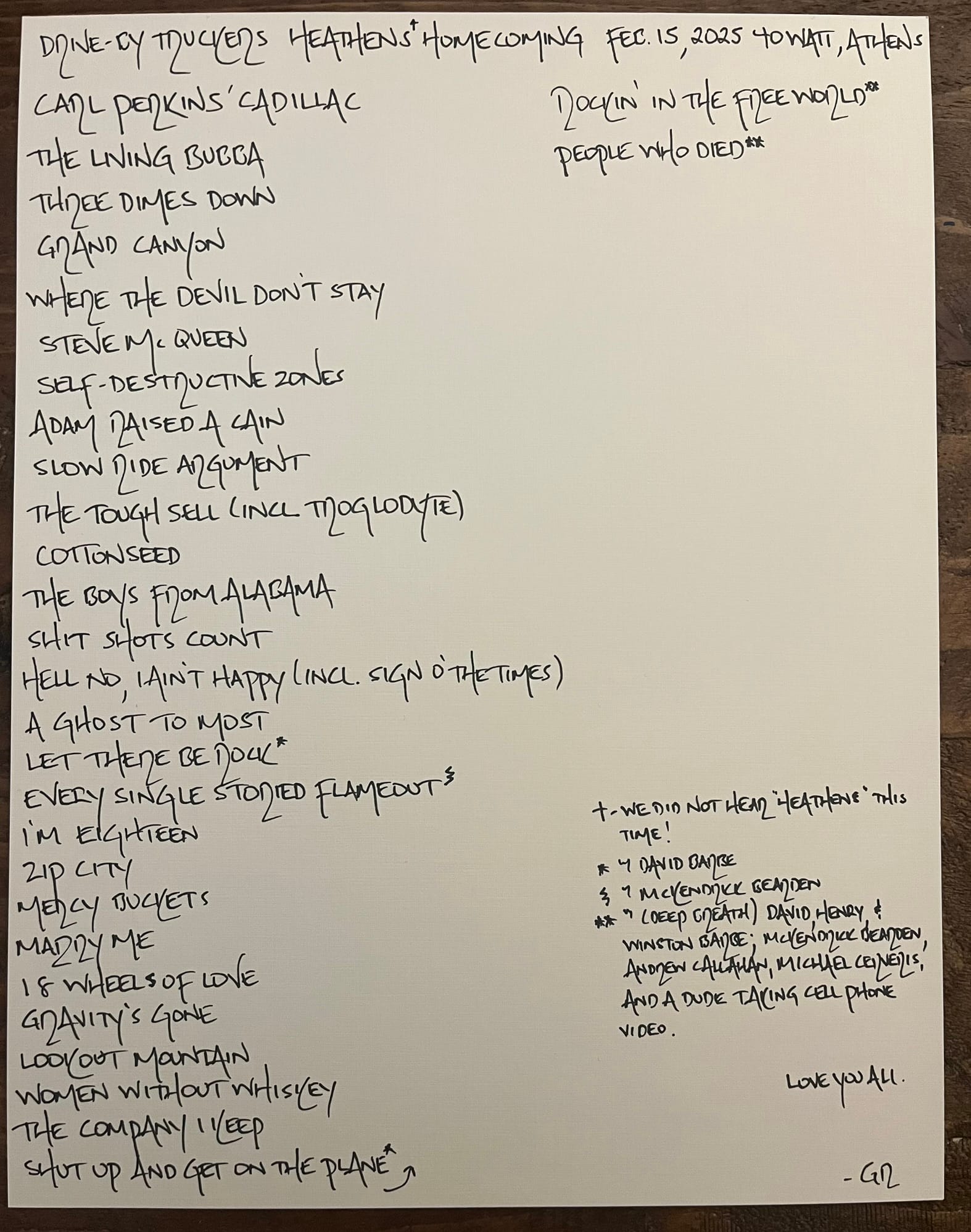
While Glenn may be a relatively “new” fan, he is a powerful thread in the tapestry of the DBT community. When he started connecting with fans, he encountered remarkable generosity and hospitality, and he pays that forward. Before I met Glenn, I knew his handwriting, thanks to the set lists he posts on Facebook. Since 2015, he has attended 57 shows (which he meticulously records in a spreadsheet!), and this year will be his eighth HeAthens Homecoming.
“It's wonderful to have conversations about this band that overtook my own consciousness and find out that I am far from alone,” Glenn says. “They are a band that rewards attention and thought.”
"I think if you're a lucky person, the art you need finds you when you need it.”
To that end, Glenn authored a collection of poems, entitled Shadow Country: Poems Inspired by Southern Rock Opera. At Homecoming 2025, he recruited fellow fans for a community reading of the collection, which you can watch here. He’s also working with a graphic artist to publish a book, expected this year.
Glenn shares one of my favorite pastimes, which is attempting to parse the lyrics of Mike Cooley songs. Keep reading to hear his hot Cooley takes, his heart-tugging fan origin story, and his outstanding album recommendations from the past year.
Mundane Mayhem is a reader-supported publication. Please consider becoming a subscriber for just $4 a month.
Where are you from originally? Do you have any connection to the South?
I like to say that I grew up on the Deep South Shore of Long Island. It's as far from North Alabama as you could possibly imagine, to some degree. But if you live there, and someone tells you “it's the South that's really racist,” you can say, “come and visit Long Island and then let's talk.”
I try not to “other” their southernness. Clearly, understanding the South through the Truckers’ eyes is not a terrible way to get a glimpse into that particular world.
I went to college in central New York, lived in Baltimore for seven years, lived in Oregon for three years, then moved back to New York City in 2000 and I've been back here for the last 25 years.
For me, I try not to “other” their southernness. I’ll give you some examples, a couple of my favorite bands: Midnight Oil could be from nowhere else other than Australia. The topics and places they sing about are fiercely Australian. When I listened to Midnight Oil, and I heard “Alice Springs” and “Yuendemu” and “ghost gum trees,” it was like traveling to a place I'd never been and still haven't been. The Tragically Hip, a Canadian band, sing songs that mention Bobcaygeon and Bill Barilko — very specifically Canadian references.
I think “write what you know” is a bit of a cliché, and sometimes that prevents artists from reaching. But when someone writes deeply about what they know, it's just fucking fascinating to me. And clearly, understanding the South through the Truckers’ eyes is not a terrible way to get a glimpse into that particular world.
When did you get into the Drive-By Truckers? Did you enter through another fandom?
I originally discovered them in Academy CD on 18th Street in New York City, probably around 2008 or so. I was flicking through the D section, and I saw the cover of A Blessing and A Curse. Wes's art, it stops you in your tracks.
I brought the CD up to the clerk, who kind of knew my taste, and I said, “will I like this?” And he said, “yeah, I think you will.” Took it home, put it on, and at that time, I remember “Gravity's Gone” really struck me. I liked the rest of it, but it didn't stick. Occasionally I would pull it out and listen to it.
That's when I found the Truckers. It was like falling in love during wartime.
Then in 2015, I saw a headline like “Drive-By Truckers Plan Career-Spanning 3 CD Live Set.” I remember thinking that would be a good way to check them out. If I had to list my five favorite albums of all time, they probably would all be live albums. So the record came out, and I got it, and from the very beginning — the first song is “Lookout Mountain” — it felt so huge and imposing and powerful. For a while, it was all I could listen to.
In 2016 — I refer to 2016 as my annus horribilis. The job that I had at Film Society of Lincoln Center, where I was the director of theater operations, was coming to an end because of differences with leadership. I had built a community there. While I was there, the staff had expanded from like 18 people to 50, and I had a significant role in building that. Out of that core group came a community, people who really cared for each other. Leaving that was profoundly painful.
When I got into the band, it gave me solace where I thought there was none. And it gave me this community that not just replaced the one that I'd lost, but became the most important community of fellow human beings I've ever known.
Around the same time, my dad was diagnosed with a lung cancer that would eventually kill him 14 months later. And then, about 36 hours after my last day at Film, I got a phone call from the executive director. She said to me that Noah Witke, who was a young man who considered me his New York dad and vice versa, had gone home after the closing night party for the New York Film Festival and attempted to access his apartment from the fire escape, because he was locked out, and fell and died. I was, along with everyone else on staff, crushed, devastated, just destroyed.
I don't know what the train conductors thought of me, every 3 or 4 days, sitting at the window seat with tears running down my face, listening to “The Living Bubba” or “Angels and Fuselage.”
For 2016 into 2017, I could basically not listen to anything other than the Truckers. After I left Film, I got a job running a program called The Hudson Valley Writers Center. I was reverse-commuting every day for about an hour and 10 minutes. For about six months of commutes, all I did was listen to the Truckers in that emotionally fraught state. I don't know what the train conductors thought of me, every 3 or 4 days, sitting at the window seat with tears running down my face, listening to “The Living Bubba” or “Angels and Fuselage” or any of the many songs on that record that just tear your heart out. When you're in an emotionally open and raw state, and you're listening to stuff that can get through your defenses, that was 2016 for me, and that's when I found the Truckers. It was like falling in love during wartime.
Shortly after I found the 3 Dimes Down forum, I posted that I had tickets to my very first Trucker show at Webster Hall and I was hoping to attend a second show the day before at The Space in Westbury, NY. Jeff Bernfeld — Beantown Bubba was his nom de 3 Dimes Down — responded by saying, “Maybe is better than no. There's a ticket in your name at the box office.” I didn't know him at all, and that simple act of casual generosity — well, this is what we do." Shortly after I found the 3 Dimes Down forum, I posted that I had tickets to my very first Trucker show in Westbury, NY, and that I was hoping to go to Webster Hall the second night, but I had a work commitment I might not be able to get out of it. Jeff Bernfeld — Beantown Bubba was his nom de 3 Dimes Down — responded by saying, “Maybe is better than no. There's a ticket in your name at the box office at Webster Hall.” I didn't know him at all, and that simple act of casual generosity — well, this is what we do.
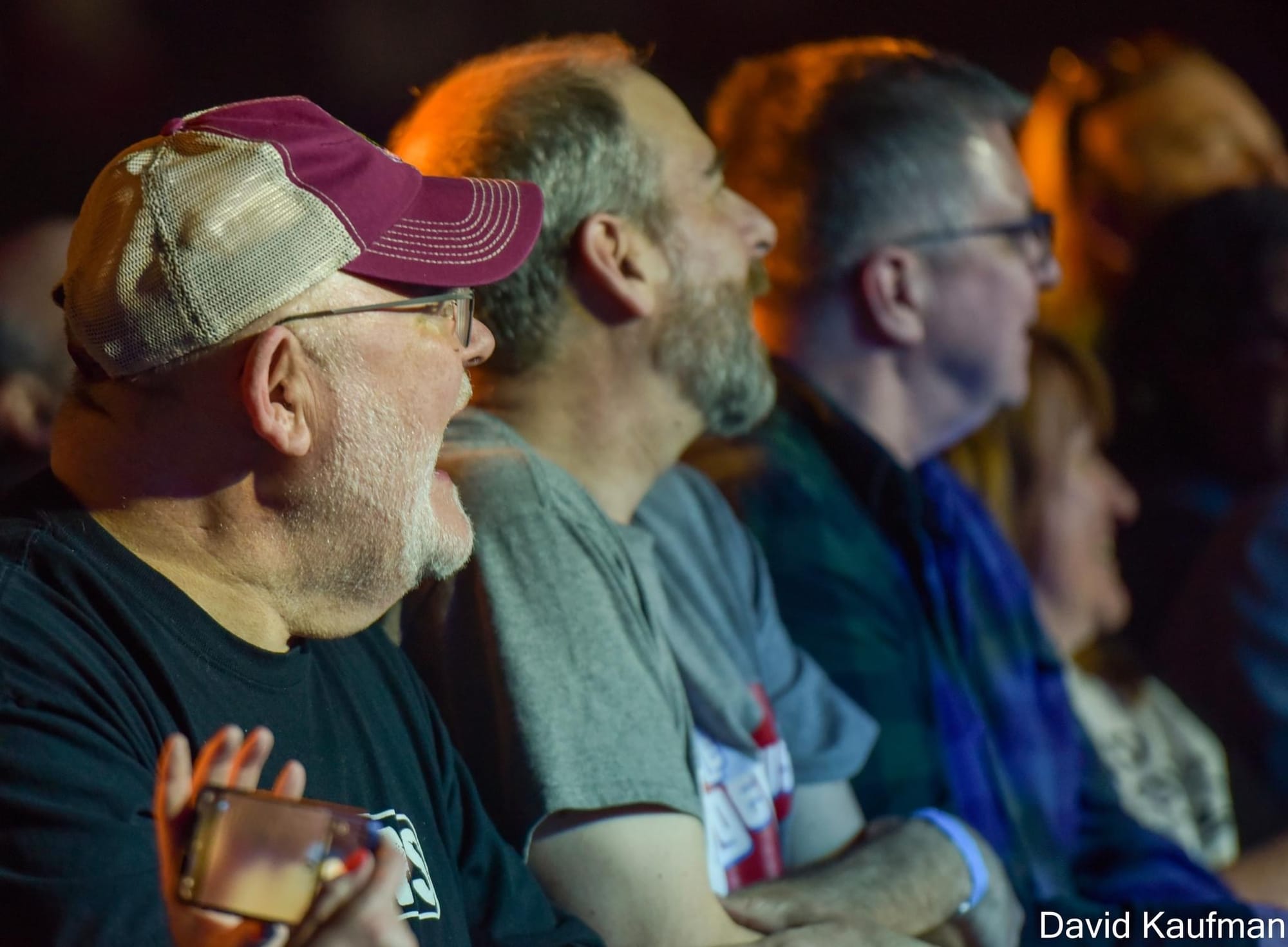
When I got to my first show, I met Sarah Rosenberg, who is one of the most extraordinary human beings I've ever met, and I met Luke and Sarah Henderson. When they heard that it was my first show, without any hesitation, they said, “well, you have to be on the rail.” When I went to my first homecoming, Sarah Henderson would introduce me to people in the community, saying “This is Glenn. He's solid.” And it is still one of the greatest compliments I've ever received.
When I got into the band, it gave me solace where I thought there was none. And it gave me this community that not just replaced the one that I'd lost, but became the most important community of fellow human beings I've ever known.
Are there certain songs that you feel like you've listened to more than any other?
With apologies to Patterson in advance — he is one of my two favorite songwriters — “A Ghost to Most” (It’s Great to Be Alive version) and “Every Single Storied Flameout.” And to why? Fuck if I know.
I'm a really rational, centered person, and I could not tell you with certainty what “A Ghost to Most” is about. It shows how great music can simply bypass your rational mind and demand your attention without analysis, and I've never had a song do that to me to such a degree. Interestingly, that feeling has helped me become more comfortable with uncertainty elsewhere in my life.
“A Ghost to Most” shows how great music can simply bypass your rational mind and demand your attention without analysis.
“Every Single Storied Flameout” is the rarest of all rock songs. It's a rock song about accountability, and that is not a topic that a rock artist will normally write about. It's about reckoning this unreckonable damage that you can do as an adult to a kid. I don't have any kids. I've never had an addictive personality. And yet, this song — it just overtook me.
When “Every Single Storied Flameout” first started appearing in the live recordings, I listened to that song more in a concentrated period than any song ever, by any artist I've ever heard. I mean six, seven, eight times a day. I would wake up with it in my head and go to sleep with it as the last thing I thought about it. I could not not listen to it. I actually have a playlist called Every “Every Single Storied Flameout,” which is exactly what it sounds like. I can listen to that playlist without ever getting tired of it.
What about songs you’ve never heard performed?
I have one from each of the songwriters, and I know for sure I haven’t heard them because I have a spreadsheet. For Patterson, “The Great Car Dealer War.” And then Cooley, “Get Downtown.” But honestly, I'm just grateful I get to hear any of their songs. There's so many great ones that it feels almost a little greedy to want more. If I hear “Women Without Whiskey,” which I've probably heard 38 times out of 57 shows, it will make me very happy.
Is there an underappreciated song that you like?
I don't know if it's underappreciated, but “Sounds Better in the Song.” The It’s Great to Be Alive version, to me, is definitive. Like with “Every Single Storied Flameout,” it's such an unusual perspective in a rock song. Accepting culpability is not something a lot of male songwriters do readily or easily.
Tell me more about the Shadow Country poetry project.
That was obviously a major fucking thing that I've done related to the Drive-By Truckers — doing an entire poetry project based on monologues, inspired by Southern Rock Opera. It’s 21 poems: 19 songs and two encores. Both of these songwriters reward some onion peeling.
I listened to that song more in a concentrated period than any song ever, by any artist I've ever heard. I mean six, seven, eight times a day.
One of the questions that I tried to answer was, who else might have something to say about these songs, either as a counterweight or an expansion? For “Zip City,” my first idea was to have it from the 15-year-old girl’s point of view, but I thought it more interesting to have it from the deacon’s point of view, looking at his daughter and seeing all the things that the protagonist can’t.
You know the famous, overused quotation by Emily Dickinson, “Tell all the truth but tell it slant”? Cooley is often so slant — witness “A Ghost to Most” — but in something like “Zip City,” it seems to be straight, and it's not. It's a miraculous sleight of hand.
Even something like “Every Single Storied Flameout,” the topic is clear; it's about a father looking at his son careening into danger and being like, I can't tell him to stop, because he'll look me in the face and say, “What the fuck about you?” But at the same time, that entire first verse about the poet — which could be Jim Morrison, could be just a random thing — it's still slant, even though later in the song, he tells it straight.
Are there any recent movies, books, or records you want to recommend to other DBT fans?
I'm a huge reader. I always recommend my friend Patrick Radden Keefe’s Say Nothing: A Tale of Murder and Memory in Northern Ireland. It's the best nonfiction book I've ever read. I love Samantha Harvey's Orbital. Claire Keegan, Small Things Like These.
And as far as records, just from this year, Tropical Fuck Storm’s album — that's their real name — Fairyland Codex. The Bill Orcutt Guitar Quartet, HausLive 4. Patterson's record, of course, but everybody knows about that one. Slow Motion Cowboys’ Wolf of St Elmo record is lovely. T. Hardy Morris, who's playing at Homecoming this year, Artificial Tears is one of my records of the year, as is The Tubs’ Cotton Crown.
And for movies and TV shows, we love Slow Horses, Severance, and The Pitt. And we really enjoyed an eccentric British show called Ludwig. The Saoirse Ronan film, The Outrun, was absolutely wonderful.
What is your favorite piece of DBT merch or memorabilia that you own?
There are two that are related. The very first T-shirt that I bought was — unsurprisingly — an It’s Great to Be Alive T-shirt, and I treat it like it's the crown jewels. It gets washed cold, and I hang it, and it's still in great condition. I'm going to be heartbroken when it goes how all things that are biodegradable go.
Obviously, It’s Great to Be Alive was my gateway drug to the band, and at a Nuci’s Space auction one year, where I didn't have the funds to bid too much, I bid on the vinyl box set of It’s Great to Be Alive. I set a limit, and after a while, the bids went above it. I didn't expect to win, but there was a little scintilla of disappointment.
The winners were announced, and Jeff Bernfeld — Beantown Bubba, the guy who gave me the ticket to one of my first shows — walked over to me and handed me the box set. He won the bidding to give it to me. I was just overwhelmed by the gesture of kindness and thoughtfulness and thinking-about-otherness of that act. If you're in the community for more than five minutes, you will see things like this happen all the time, so I try to practice that myself. I wish this was the way the world was.